

If you have ever come across a real estate syndication, a private fund, or a crowdfunding platform like CrowdStreet that requires “accredited investor” status before you can even view a deal, you already know why learning how to become an accredited investor matters. It is not a title you apply for. It is a status you qualify for under rules written by the Securities and Exchange Commission (SEC), and once you meet one of a handful of specific tests, an entire category of private investment opportunities opens up that simply is not available to the general public.
This guide walks through exactly how to become an accredited investor, what the SEC actually requires, how verification works in practice, and why this status matters more for real estate investors specifically than for almost any other type of investor.
This article is for general informational purposes only and is not financial or legal advice. Speak with a qualified financial advisor, attorney, or CPA before making decisions based on your accredited investor status.
What Is an Accredited Investor?
An accredited investor is an individual or entity that the SEC considers financially sophisticated enough to evaluate the risks of unregistered, private investments, meaning investments that are not registered with the SEC and do not carry the same disclosure requirements as public stocks or mutual funds. This status is defined under Rule 501 of Regulation D, a section of federal securities law that governs private securities offerings. The SEC’s own accredited investor overview breaks down the official criteria in more detail.
There is no certificate, no government-issued card, and no formal application process for becoming an accredited investor. Instead, you become accredited the moment you satisfy one of the SEC’s qualifying tests, and it is up to the company, fund, or platform offering the investment to confirm that you actually meet the criteria before letting you invest.

Why Real Estate Investors Care About This More Than Most
Here is the piece most general finance guides skip entirely: for real estate specifically, accredited investor status is not just a nice-to-have. It is the gatekeeper to an entire asset class.
Real estate syndications, private real estate funds, and many crowdfunding platforms are structured as Regulation D private placements. That means, by law, they can only be marketed to accredited investors, or to a limited number of sophisticated non-accredited investors under stricter conditions. Publicly traded REITs remain open to everyone, but the higher-yield, professionally managed deals, apartment complex syndications, commercial developments, ground-up construction projects, are largely locked behind this single qualification.
In practice, this means two investors with identical interest in real estate can have completely different access. One, who meets the income or net worth threshold, can review and invest in a multifamily syndication targeting a specific market. The other, who does not, is limited to publicly traded REITs and crowdfunding deals open to non-accredited investors, which tend to offer lower minimums but also less direct control and, often, lower potential returns. Understanding how to become an accredited investor is, in a very real sense, understanding how to unlock the next tier of real estate investing.
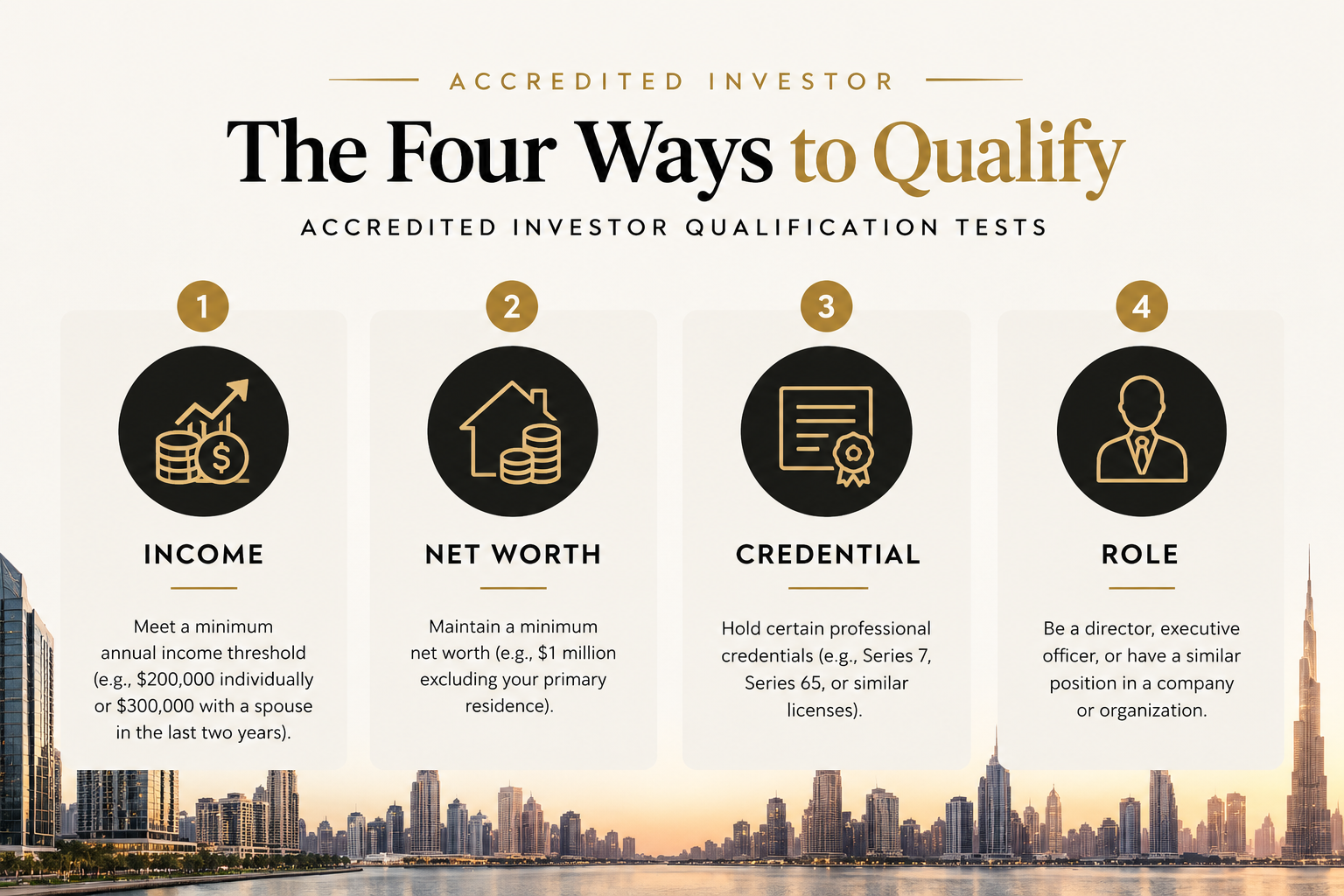
The Four Ways to Qualify as an Accredited Investor
There is no single path here. The SEC recognizes four distinct routes, and you only need to satisfy one.
1. The Income Test
This is the most common way individuals learn how to become an accredited investor. You qualify if:
- Your individual income exceeded $200,000 in each of the two most recent years, with a reasonable expectation of reaching that level again this year, or
- Your joint income with a spouse or spousal equivalent exceeded $300,000 in each of those two years, with the same forward-looking expectation
One detail that trips people up: if you earned $200,000 individually in year one but only reached $300,000 jointly in year two without hitting $200,000 individually, that does not satisfy the test. The individual or joint threshold needs to be met consistently across both years under the same calculation method.
2. The Net Worth Test
You qualify if your net worth, individually or jointly with a spouse, exceeds $1 million, excluding the value of your primary residence. Net worth is calculated as total assets minus total liabilities, and any mortgage debt on your primary residence beyond the home’s value can also factor into the calculation.
This is often the more relevant test for real estate investors specifically, since many people building wealth through property already have substantial equity in investment properties, even if their annual income does not hit the six-figure income threshold.
3. Professional Credentials
Since a 2020 SEC rule change, holding certain FINRA-issued licenses in good standing qualifies you as an accredited investor regardless of income or net worth. The recognized credentials are the Series 7, Series 65, and Series 82 licenses. This was the first time the SEC allowed professional knowledge, rather than a balance sheet, to stand in as proof of financial sophistication. You can verify any Series 7, 65, or 82 license through FINRA BrokerCheck.
4. Professional Role or Entity Ownership
If you are a director, executive officer, or general partner of the company or fund issuing the securities, you automatically qualify, regardless of your personal finances. Certain entities can also qualify collectively, including trusts with over $5 million in assets, family offices meeting SEC criteria, and entities where every individual owner is independently accredited. An LLC, for example, can qualify as an accredited investor either by having $5 million or more in total assets or by ensuring every one of its beneficial owners is independently accredited.
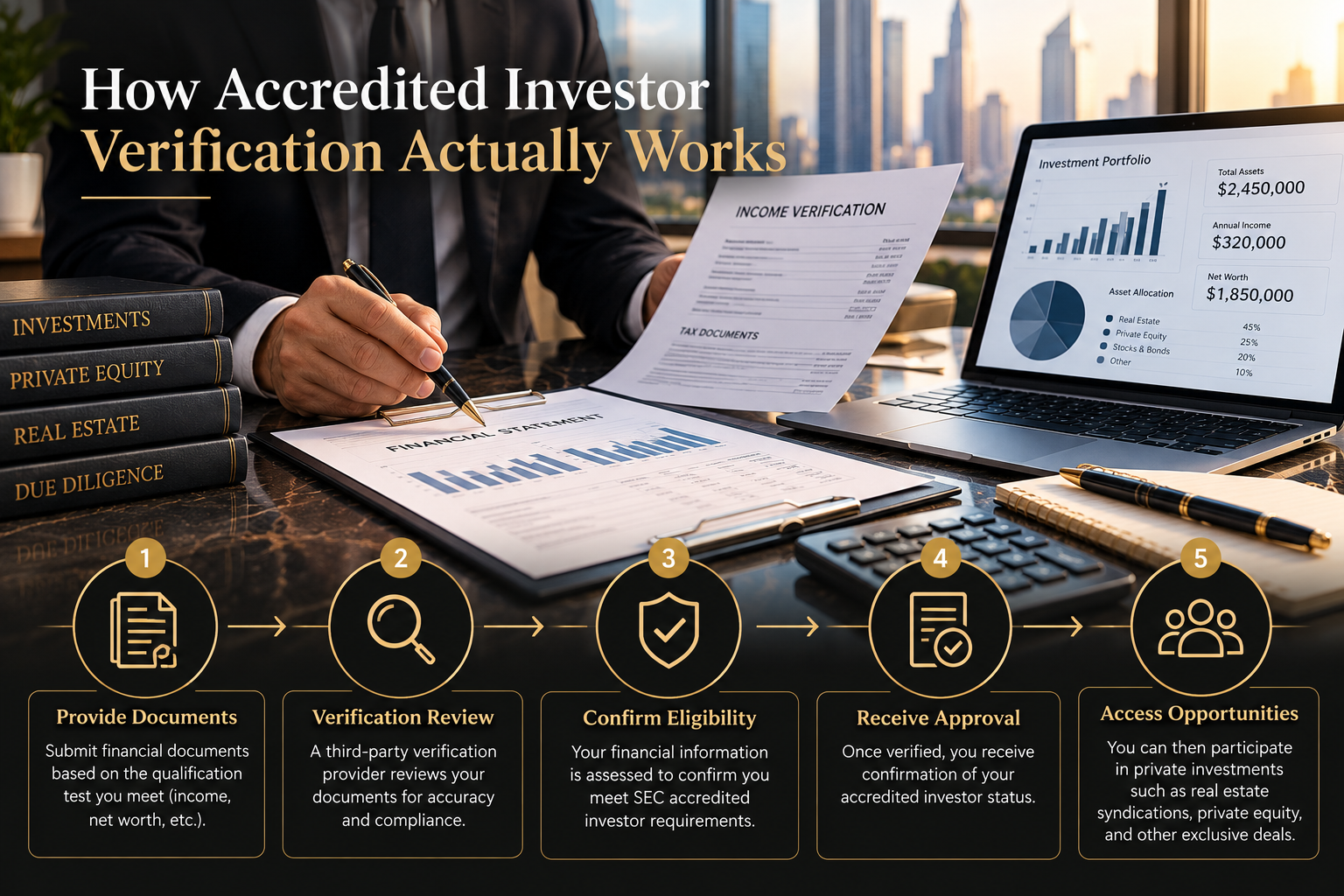
How Accredited Investor Verification Actually Works
Because there is no government registry of accredited investors, the responsibility to verify your status falls on whoever is offering the investment. In practice, verification usually happens one of a few ways:
- Document review. Tax returns, W-2s, or pay stubs for income verification; bank statements, brokerage statements, and credit reports for net worth verification
- Third-party confirmation. A letter from a CPA, attorney, investment advisor, or broker-dealer confirming you meet the criteria
- Third-party verification services. Platforms like Parallel Markets or Verify Investor specialize in confirming accredited status and issuing a reusable verification that multiple platforms can accept
- Self-certification. For some older or lower-risk offerings, a signed questionnaire may be sufficient, though this has become less common as scrutiny around Regulation D offerings has increased
Real estate crowdfunding platforms and syndicators generally lean toward document review or third-party verification, since the SEC has placed increasing emphasis on issuers actually confirming accredited status rather than simply taking an investor’s word for it.
Do You Need to Reapply Every Time You Invest?
This is one of the more common points of confusion. Accredited investor status is not a one-time designation that follows you everywhere. Each time you invest in a new private offering, that specific issuer or platform is generally responsible for verifying your status again, though third-party verification services have made this process faster by allowing you to reuse a recent verification across multiple platforms within a limited window, typically around 90 days.
Common Misconceptions
A few misunderstandings come up often enough to address directly:
- “I need to apply through the SEC.” There is no SEC application. The SEC sets the criteria; individual issuers confirm you meet it.
- “Accredited investor and qualified purchaser are the same thing.” They are not. A qualified purchaser is a separate, higher SEC threshold, generally $5 million or more in investments, used for certain private funds. Every qualified purchaser is accredited, but not every accredited investor is a qualified purchaser.
- “Once I qualify, I’m accredited forever.” Your status is generally tied to your current financial situation and needs to be reverified for new investments.
- “Accredited investors get better legal protection.” The opposite is often true. Private, unregistered offerings carry fewer disclosure requirements than public securities, which is exactly why the SEC restricts them to investors presumed capable of evaluating that added risk on their own.

Is Becoming an Accredited Investor Worth It for Real Estate?
For investors serious about moving beyond publicly traded REITs and into direct real estate syndications or private funds, meeting the criteria for how to become an accredited investor genuinely changes what is available to you. It opens access to deals with the potential for stronger risk-adjusted returns, more direct involvement in specific properties or markets, and partnerships with experienced sponsors and syndicators.
That said, it is not automatically the right move for everyone. Private real estate investments are typically illiquid, meaning your capital can be tied up for years with no ability to sell quickly if you need the cash. They also carry less regulatory oversight than public securities. Meeting the accredited investor threshold is a qualification, not a recommendation, and it is worth evaluating each specific opportunity on its own merits rather than treating accredited status as a green light to invest in anything available.
Conclusion
Learning how to become an accredited investor ultimately comes down to meeting one of four SEC-defined tests: income, net worth, professional credentials, or a qualifying professional role. For most individual investors, the income and net worth tests remain the most common routes. For real estate investors specifically, this status is often the deciding factor in whether you have access to institutional-quality private deals or are limited to publicly traded alternatives. Understanding exactly where you stand against these thresholds, and keeping the right documentation ready, is the real first step toward using accredited status to your advantage.
For more on how accredited status connects to real estate investing strategy, explore our Property Investment coverage, including our guide on building passive income through real estate.
Frequently Asked Questions
What is an accredited investor?
An accredited investor is an individual or entity that meets specific SEC-defined income, net worth, or professional credential thresholds, allowing access to private investments not registered with the SEC.
What are the requirements to become an accredited investor?
You can qualify through individual income over $200,000 (or $300,000 joint) for two consecutive years, a net worth over $1 million excluding your primary residence, holding a Series 7, 65, or 82 license, or serving as a director, executive officer, or general partner of the issuing company.
How do you prove you are an accredited investor?
There is no official certificate. Issuers typically verify status through tax documents, bank or brokerage statements, or a written confirmation from a CPA, attorney, or licensed financial professional.
Can an LLC be an accredited investor?
Yes. An LLC can qualify as an accredited investor if it has over $5 million in total assets, or if every individual beneficial owner of the LLC independently meets the accredited investor criteria.
What is the difference between an accredited investor and a qualified purchaser?
A qualified purchaser is a higher SEC threshold, generally requiring at least $5 million in investments, used for certain private funds. All qualified purchasers meet the accredited investor definition, but not all accredited investors meet the qualified purchaser threshold.
Does accredited investor status expire?
Your status itself does not expire, but because it is based on your current financial situation, each new investment typically requires fresh verification, generally accepted within about a 90-day window from a recent confirmation.
Am I an accredited investor?
You may be an accredited investor if you earned over $200,000 individually (or $300,000 jointly) in each of the last two years, have a net worth over $1 million excluding your primary residence, or hold a Series 7, 65, or 82 license.