

Walk through the center of almost any city and certain buildings tend to stand out, not because they’re the tallest or the most modern, but because they carry a different kind of weight. A courthouse, a library, a city hall. These aren’t just functional structures. They’re built to represent something larger than themselves, a community, a government, a shared set of values. That’s the essence of what is civic architecture, and it’s a field that shapes far more of daily life than most people realize.
Defining Civic Architecture: What Sets It Apart
At its core, civic architecture refers to the design and construction of buildings and spaces intended for public use, structures that serve a community rather than a private owner or business. Courthouses, city halls, libraries, schools, post offices, and public memorials all fall under this category. The defining feature isn’t necessarily the building’s style or size, it’s who it’s built for and what purpose it serves.
Civic buildings are typically funded, at least in part, by public money and are meant to remain useful and relevant for generations, not just a single business cycle. That long-term thinking tends to influence everything about how they’re designed, from the materials chosen to how much symbolism gets built into the facade. Unlike a private residence or a retail store, a civic building answers to an entire community rather than a single client, which changes the entire design conversation from the first sketch onward.

From Ancient Forums to Modern City Halls: A Brief History
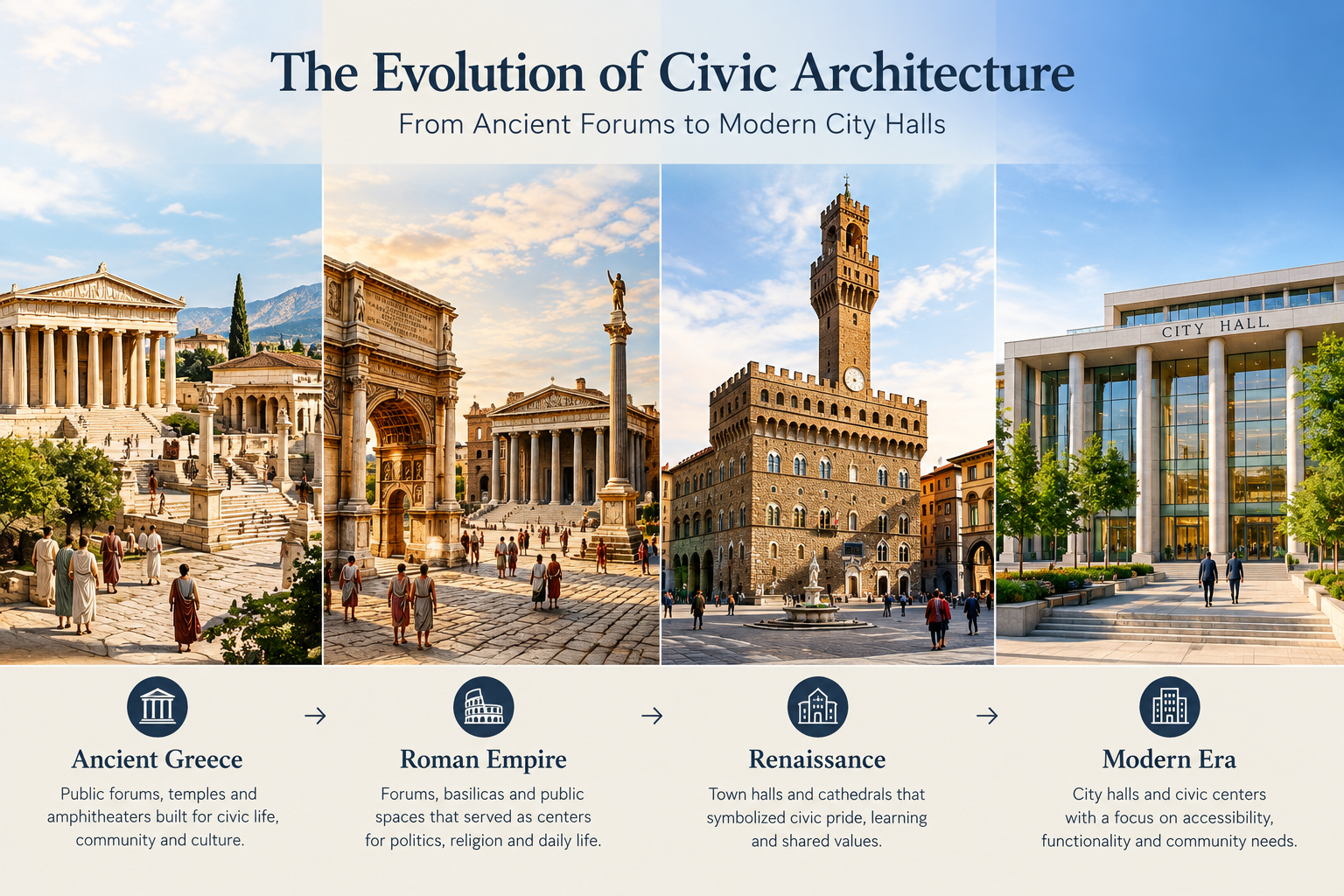
Civic architecture isn’t a modern invention. Ancient Greek and Roman societies built public structures, forums, temples, amphitheaters, specifically to be sturdy, functional, and visually impressive, reflecting the pride of the city they served. The Roman Forum, for instance, wasn’t just a marketplace, it was where politics, religion, and daily civic life all intersected in one physical space. That tradition carried through the Middle Ages and Renaissance, where town halls and cathedrals often served as the literal and symbolic center of a community.
The idea that public buildings should inspire, not just function, shows up repeatedly throughout history. The English architect Sir Christopher Wren once described public buildings as ‘the ornament of a country’, arguing that great architecture could draw people together and instill pride in a nation. You can read more about this historical debate over civic design in the official Federal Register documentation on federal architecture policy.
In the mid-20th century, that classical influence gave way to modernist design across much of the US federal government, a shift that’s still debated today. As recently as 2025, the US federal government issued new architectural guidance aimed at prioritizing traditional and regionally appropriate design for new federal buildings, a reminder that debates over what civic architecture should look like are still very much ongoing, even in 2026.
What Makes a Building “Civic”? Core Design Traits
While civic buildings vary enormously in style across different eras and countries, a few traits tend to show up again and again:
- Public accessibility. Civic buildings are meant to be entered and used by the general public, not restricted to a select few. This isn’t just a legal requirement in most places, it’s baked into the philosophy of the building type itself.
- Symbolic design elements. Columns, domes, grand entrances, and other symbolic features are often used to convey permanence, authority, or democratic values, even when the underlying structure is fairly modest.
- Durability and longevity. These buildings are typically constructed to last for generations, using materials chosen for durability over trend. A civic building isn’t designed with a 10-year lifespan in mind the way a retail storefront might be.
- Context sensitivity. Good civic architecture tends to reflect and respect the surrounding neighborhood rather than clashing with it, even while still standing out as a notable structure.
- Functionality for public use. Layouts are designed around how large numbers of people will move through and use the space, whether that’s a courtroom, a library reading room, or a city council chamber during a packed public meeting.
Categories of Civic Buildings, With Real-World Examples
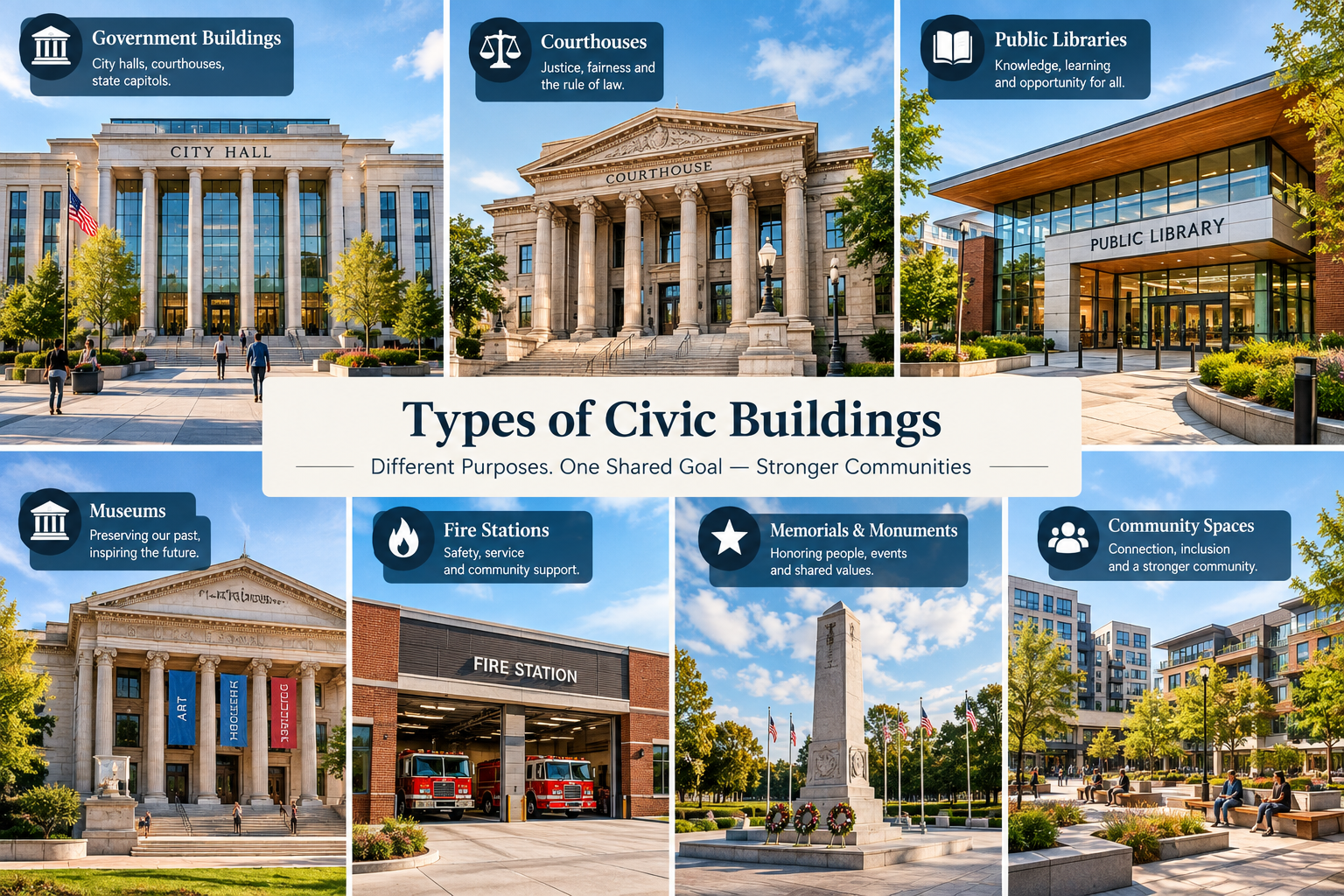
Civic architecture covers a wide range of building types, each serving a different public function:
- Government buildings: city halls, courthouses, state capitols
- Educational buildings: public schools, universities, libraries
- Cultural institutions: museums, theaters, concert halls
- Public safety facilities: fire stations, police stations
- Memorials and monuments: war memorials, civic statues, commemorative sites
- Community spaces: public plazas, civic centers, community halls
Some of the most recognizable examples of civic architecture in the US include the Lincoln Memorial in Washington, D.C., built to honor a national figure while doubling as a public gathering space, and the US Capitol Building, whose classical dome has become a global symbol of democratic government. On a smaller scale, thousands of local libraries, courthouses, and town halls across the country do the same job on a community level, giving a neighborhood a physical center point, even if they never make it into a history textbook.
Why Civic Architecture Matters to Everyday Life
Civic architecture matters because these buildings do more than just house government functions or public services. They shape how people experience and identify with the place they live.
A well-designed civic building can foster a sense of pride and belonging, giving a town or city a recognizable identity. It can also influence how welcome people feel engaging with public institutions, a courthouse designed to feel intimidating sends a very different message than one designed to feel open and accessible. Beyond symbolism, civic buildings often anchor economic activity in a neighborhood, drawing foot traffic and investment to the surrounding area, in much the same way a well-placed park or plaza can lift property values nearby.
There’s also a practical, long-term value here. Because civic buildings are built to last for decades, sometimes centuries, the design decisions made today have consequences far beyond the current generation of residents.
Where Civic Architecture Is Headed: Current Trends
Civic architecture today is shaped by a few clear priorities that weren’t nearly as central a few decades ago.
Sustainability has become a major focus, with more civic buildings incorporating green roofs, solar panels, natural lighting, and energy-efficient systems to reduce their environmental footprint and long-term operating costs, savings that matter significantly given how long these buildings stay in service.
Adaptive reuse is also on the rise. Rather than demolishing older structures, cities are increasingly converting old post offices, warehouses, and factories into libraries, community centers, and cultural spaces. This approach preserves architectural history while cutting down on construction waste, and it often costs less than starting from scratch.
Accessibility and inclusive design have moved from an afterthought to a core requirement. Ramps, wide doorways, tactile signage, and barrier-free layouts are now standard expectations rather than optional add-ons, ensuring civic spaces genuinely serve the entire public they’re meant for.
At the same time, there’s an ongoing debate about aesthetic direction, whether contemporary civic buildings should lean toward modern, minimalist design or return to more traditional, classical styles. Recent federal policy shifts in the US suggest this conversation is far from settled, with renewed interest in traditional design for major government buildings.
Civic vs. Public vs. Commercial Architecture: Knowing the Difference
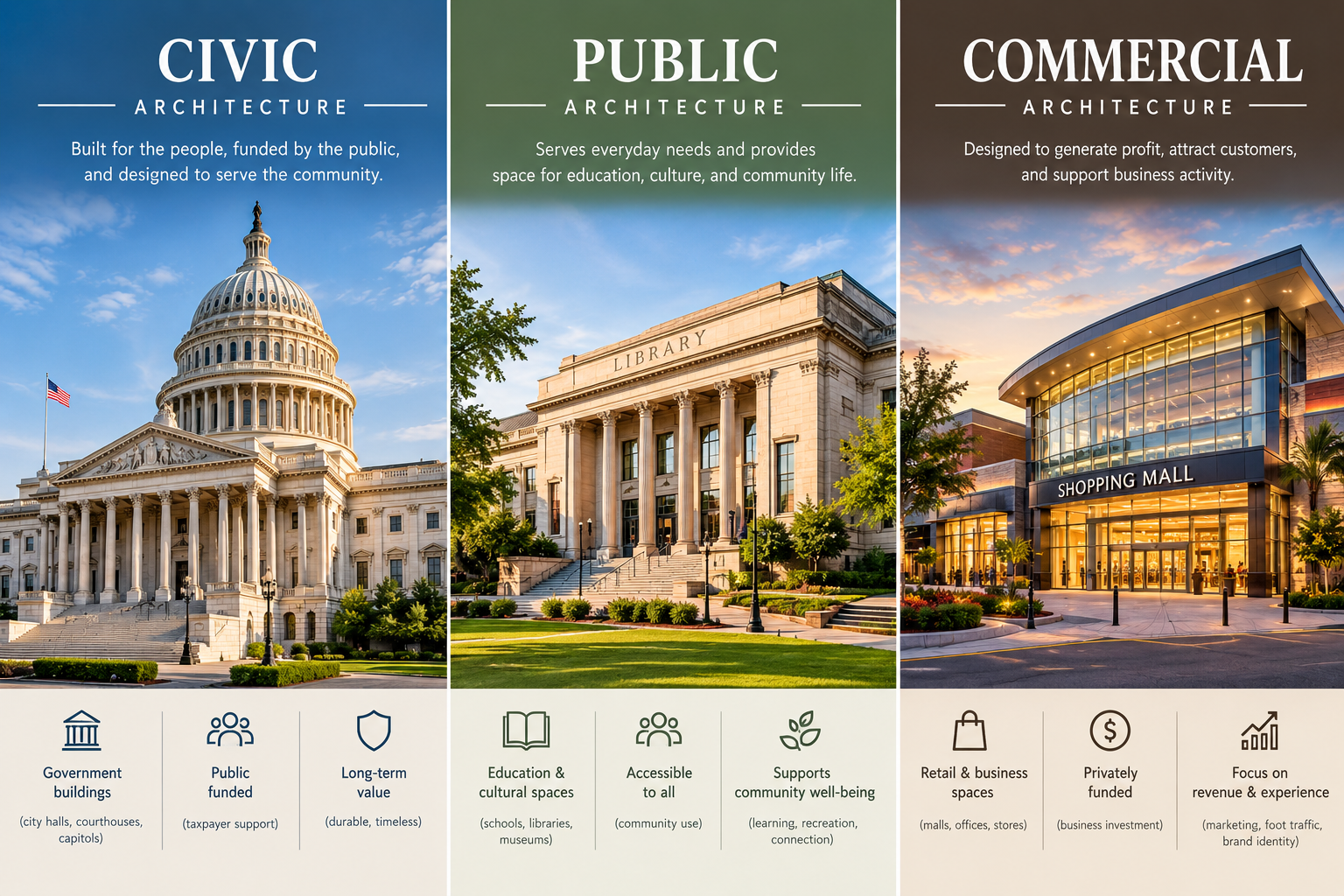
It’s easy to confuse civic architecture with public or commercial architecture, but the distinctions matter quite a bit once you start looking closely.
Civic vs. public architecture: Public architecture is a broader category that includes any building the general public can access, think airports, stadiums, or shopping malls. Civic architecture is more specific, referring to buildings tied directly to government, public service, or shared civic life, like courthouses or city halls. In other words, all civic architecture is public, but not all public architecture is civic.
Civic vs. commercial architecture: Commercial buildings exist primarily to generate profit for a private owner. Civic buildings exist to serve the public, funded largely through public resources rather than private investment. That fundamental difference in purpose shapes nearly every design decision, from budget priorities to how long the building is expected to remain in use, and even how much input the surrounding community gets during the design process.
Core Principles Behind Great Civic Design
A handful of design principles tend to guide most successful civic architecture projects, regardless of budget or location:
- Design for the community first. Architects typically hold public consultations to understand a community’s actual needs before finalizing a design, rather than imposing a vision from the top down.
- Balance beauty and function. A civic building needs to work well operationally while still contributing something meaningful to the visual identity of its surroundings.
- Respect the surrounding context. New civic buildings are generally expected to complement the architectural character of their neighborhood rather than clash with it.
- Build for accessibility. Every civic space should be usable by people of all physical abilities, without exception.
- Design for durability. Materials and structural choices reflect the fact that these buildings are meant to serve the public for generations, not just until the next renovation cycle.
A Mirror of Society: What Civic Buildings Reveal About Us
Perhaps more than any other building type, civic architecture acts as a mirror for what a society prioritizes at a given moment in time. Grand, classical courthouses from the 19th century reflected a belief in permanence and institutional authority. Stripped-down modernist government buildings from the mid-20th century reflected a different set of values, efficiency, progress, a deliberate break from tradition. Today’s growing focus on sustainability and accessibility in civic design reflects current priorities around environmental responsibility and inclusivity.
In that sense, studying what is civic architecture in a given era tells you almost as much about that society’s values as reading its history books would. Future generations will likely look back at today’s civic buildings and draw their own conclusions about what mattered most to us.
Conclusion
Civic architecture sits at an interesting intersection of art, public service, and community identity. It’s not just about constructing a functional building, it’s about creating a space that represents shared values and stands the test of time. From ancient forums to modern, sustainable city halls, the core idea has stayed remarkably consistent: public buildings should serve their community while reflecting the pride and priorities of the people they represent. Understanding what civic architecture is, and why it’s designed the way it is, offers a genuinely useful lens for seeing the cities we live in a little differently.
For more on how design shapes the spaces we live and work in, explore our Architecture coverage.
Frequently Asked Questions
What is civic architecture in plain terms?
Civic architecture is the design of buildings meant for public use, things like courthouses, libraries, and city halls, funded largely through public money and built to serve a community rather than a private owner.
What are some US civic architecture examples?
The Lincoln Memorial, the US Capitol Building, and countless local courthouses, libraries, and city halls across the country are all examples of civic architecture in the US.
How is civic architecture different from commercial buildings?
Commercial buildings are built primarily to generate profit for a private owner, while civic buildings are built to serve the public and are typically funded through public resources.
Why does civic architecture matter in cities?
It shapes how people experience and identify with the place they live, often anchoring a neighborhood’s identity and influencing how welcoming public institutions feel.
What are the key traits of civic architecture?
Public accessibility, symbolic design elements, durability, and a strong sense of context are among the most common traits of civic architecture.
How has civic architecture changed in recent years?
Modern civic architecture increasingly prioritizes sustainability, adaptive reuse of older buildings, and inclusive, accessible design, alongside an ongoing debate over traditional versus contemporary style.