
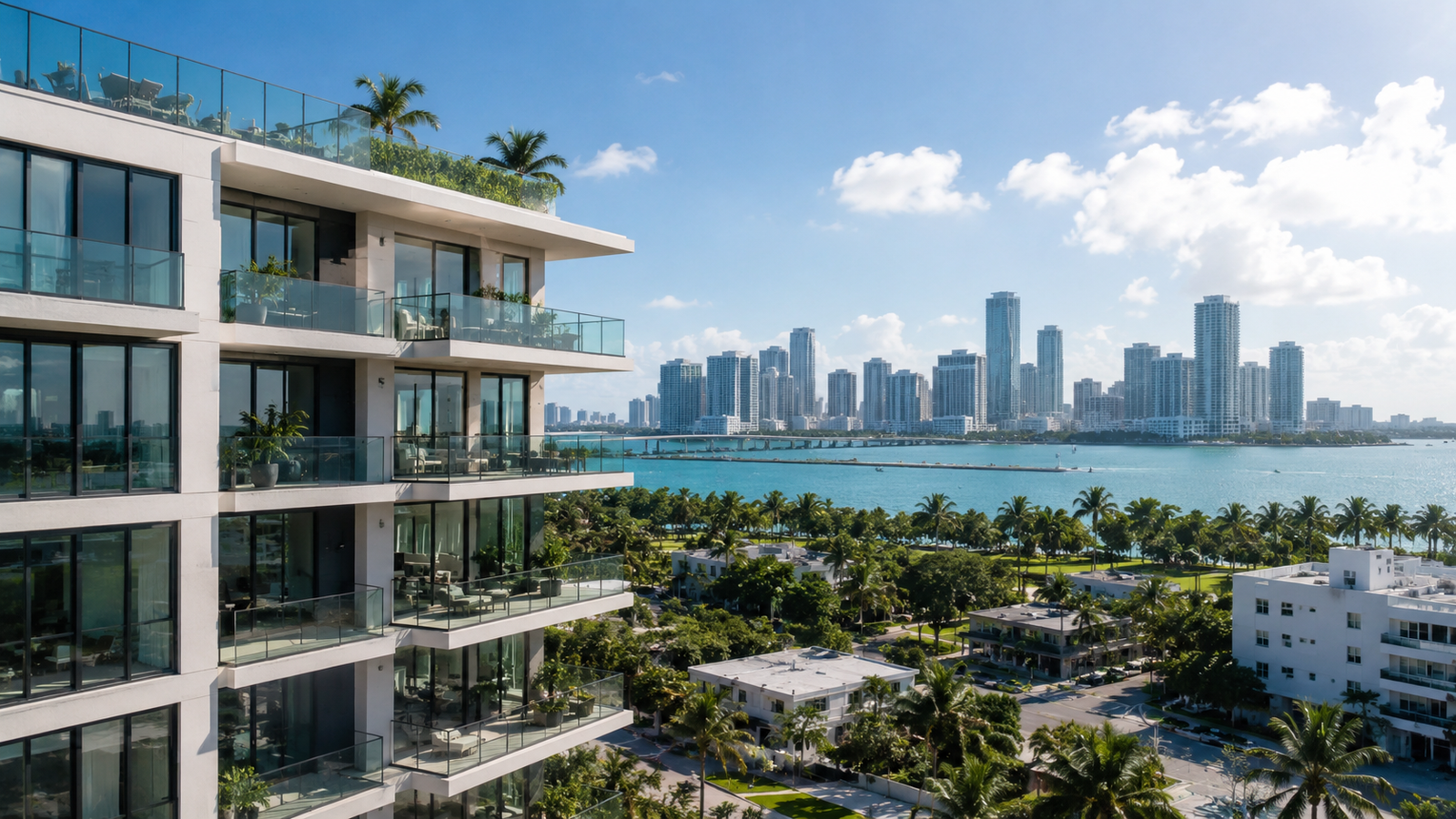
Miami’s luxury property market in 2026 is no longer defined simply by high prices and ocean views. It has become a more sophisticated global market in which location, building quality, ownership costs, buyer profile and long-term liquidity can matter as much as the purchase price itself.
That matters especially for international buyers. South Florida continues to attract global wealth, but the strongest opportunities are increasingly found by investors who separate lifestyle appeal from investment fundamentals. The goal should not be to buy “a Miami property.” It should be to buy the right asset, in the right submarket, for a clearly defined use case.
Recent market data helps explain why. MIAMI REALTORS® reported that Miami-Dade sales of homes priced at $1 million and above rose 29.1% year over year in June 2026. Its first-half 2026 luxury report also placed the Miami-Dade single-family luxury threshold—the top 5% of sales—at about $4.3 million, while the luxury condominium threshold reached about $3.4 million.
1. Understand What “Luxury” Means in Miami Now
A seven-figure budget does not automatically place a buyer in the same competitive set across Miami. The market stretches from smaller luxury condominiums to branded residences, waterfront penthouses, gated estates and ultra-prime homes in enclaves where transactions can exceed tens of millions of dollars.
The useful question is therefore not whether a property is marketed as luxury, but where it sits within its own submarket. Compare the residence with genuinely competing properties: similar buildings, views, floor plans, age, amenities, waterfront access and service levels.
This matters because the first half of 2026 pushed South Florida’s luxury thresholds higher. MIAMI REALTORS® reported a $3.3 million luxury threshold across the five-county region and a $10.7 million ultra-luxury threshold for the top 1% of sales. Miami-Dade remained above those regional figures.
2. Treat International Demand as a Structural Feature—Not a Guarantee
Miami is unusually international for a U.S. residential market. MIAMI REALTORS® reported that international buyers accounted for 49% of new South Florida construction, pre-construction and condo-conversion purchases across an 18-month period ending in July 2025.
That depth of overseas demand can support liquidity in developments and neighborhoods with genuine international appeal. It also creates a mature ecosystem of brokers, attorneys, tax professionals, property managers and developers accustomed to cross-border transactions.
But foreign demand should never be used as a substitute for underwriting. A project may be popular with overseas buyers and still be a weak purchase at the wrong price. Currency exposure, financing terms, taxes, insurance, association costs and resale competition can all change the economics of a deal.
3. Choose the Submarket Before You Choose the Residence
Brickell, Miami Beach, Coconut Grove, Coral Gables, Downtown Miami and the waterfront communities farther north can all be described as luxury markets, but they serve different buyer profiles. An investor focused on executive rentals may value proximity to employment centers and walkability, while a second-home buyer may prioritize waterfront access, privacy and hotel-level services.
Before touring individual properties, study the broader property investment landscape and narrow the search to two or three submarkets. This prevents the common mistake of comparing properties that look similar online but serve completely different demand pools.
A practical comparison should include recent transactions, active inventory, days on market, new-construction pipeline, rental restrictions, neighborhood infrastructure and the depth of the likely resale audience.
4. Build a Market-Research Process Before You Start Negotiating
Strong luxury purchases usually begin with a repeatable research process rather than a single attractive listing. Start by comparing neighborhoods, property types and current inventory, then verify the specific building and unit with professional, property-level due diligence.
For buyers researching Miami, NestVira can be used as an initial market-discovery resource for exploring local real estate and narrowing the areas and property types worth investigating further. That first-stage research should then be combined with current comparable sales, association documents, title work, inspections and advice from qualified local professionals.
The discipline is important because luxury properties are less interchangeable than mass-market housing. View orientation, ceiling height, private elevator access, parking, marina access, floor plan, terrace depth and even the reputation of a particular line within a building can materially affect resale value.
5. Underwrite the Building, Not Just the Unit
For condominium buyers, the financial and physical condition of the building deserves the same attention as the apartment itself. Monthly fees can differ dramatically between properties with similar purchase prices, and special assessments can change the true cost of ownership.
Review the association’s financial statements, reserves, insurance position, planned capital work, meeting minutes and any known assessments. Understand which services are included in the monthly fee and which costs remain the owner’s responsibility.
In a premium building, higher fees are not automatically a negative. Full-service staffing, security, valet operations, private amenities and extensive common areas cost money. The key question is whether the service level supports the property’s positioning and whether future buyers will view those costs as reasonable.
6. Separate Lifestyle Value From Investment Return
Luxury real estate often produces two different forms of value: financial return and personal utility. A buyer may happily accept a lower rental yield in exchange for ocean frontage, privacy, a particular architectural experience or the ability to use the residence personally for part of the year.
Problems arise when the buyer expects both maximum lifestyle value and maximum investment yield from the same property without testing the numbers. Before purchasing, model realistic rent, vacancy, management, insurance, taxes, association fees, maintenance and furnishing costs.
If rental income is part of the thesis, verify the building’s leasing rules before relying on projected revenue. Minimum lease periods, application procedures, rental caps and short-term-rental restrictions can vary materially between properties.
7. Think About the Exit Before the Purchase
The most expensive property is not necessarily the most liquid. Luxury buyers are selective, and small differences in location, building reputation, condition or view can narrow the future buyer pool.
Before making an offer, ask who is likely to buy the property from you in five or ten years. Is the likely buyer a local primary resident, a domestic high-net-worth household, an international purchaser, or an investor? Following current real estate market coverage can help buyers stay aware of the broader trends affecting those audiences.
This is where scarcity becomes important. Protected views, true waterfront positioning, unusually large floor plans, limited-edition residences and established neighborhoods can be harder to replicate than fashionable finishes. In a long holding period, durable scarcity can matter more than short-term design trends.
The Bottom Line
Miami luxury real estate enters the second half of 2026 with meaningful momentum. Million-dollar sales are rising, luxury price thresholds have moved higher, and international demand remains deeply embedded in the South Florida market.
Yet the market rewards precision. International buyers should resist the temptation to treat Miami as one uniform investment destination. The better approach is to define the intended use, choose the right submarket, understand the building economics, verify ownership costs and consider the eventual resale audience before negotiating.
For buyers who follow that process, Miami can offer something relatively rare: a globally recognized lifestyle market with deep international participation and a wide range of property types. The opportunity is real—but so is the need for disciplined due diligence.
Quick Takeaways for International Buyers
- Miami-Dade’s luxury price thresholds moved materially higher in the first half of 2026.
- International buyers remain a major force in South Florida new-construction sales.
- Neighborhood and building selection matter more than the broad “Miami” label.
- Association costs, insurance and future assessments should be underwritten before purchase.
- Rental strategy and building rules must be verified rather than assumed.
- A strong exit thesis is especially important in the luxury segment.