
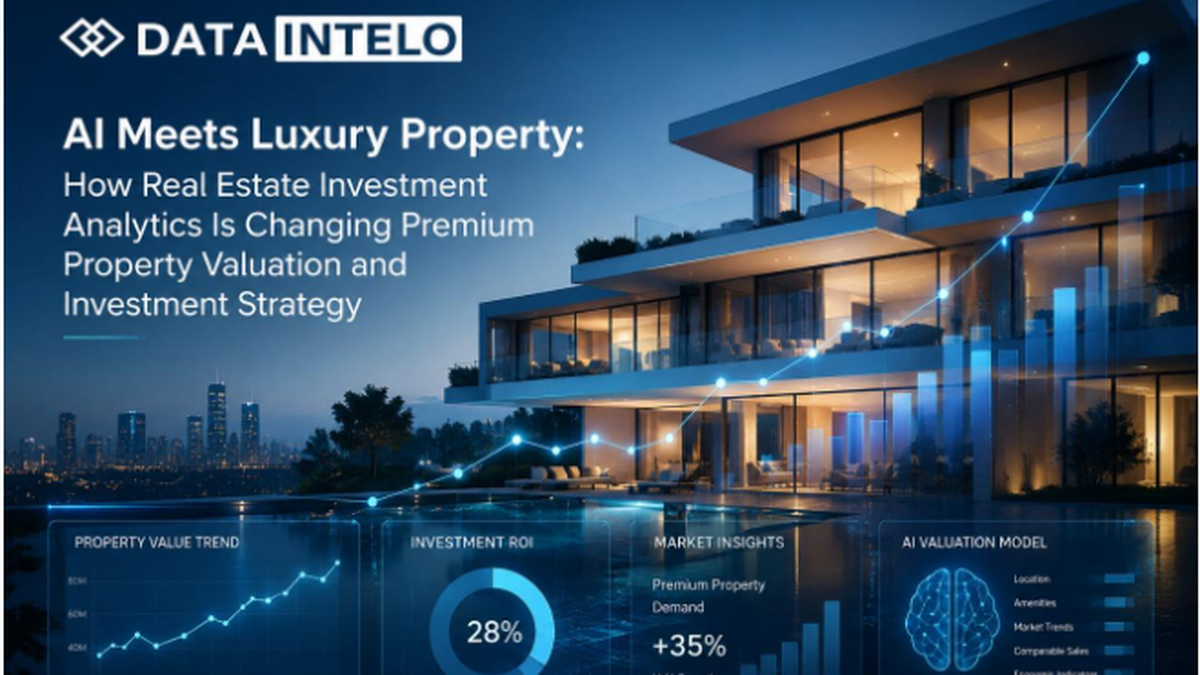
Traditionally, luxury property valuations have relied on expert judgment, limited comparable data, and contacts. This is now changing. AI-based real estate investment analytics platforms are applying institutional-grade, data-driven rigor to a field that has previously relied on subjectivity. In doing so, they are changing how expensive houses, luxury branded properties, high-prized assets, and high-value business properties are valued, bought, and handled in international financial centers.
According to DataIntelo, the global real estate investment analytics AI market was expected to be worth $4.8 billion in 2025, with growth of 18.9% forecast each year from 2026 to 2034, bringing a total value of $22.6 billion at the end of the period. The explosion of growth signifies an important change: investors in luxury real estate use data, algorithms, and scenario modeling just as they use legal due diligence and architecture.
From “Priced by Perception” to “Priced by Intelligence”
The evaluation of premium real estate is always tricky since every single house includes some distinct architecture, views, amenities, and specified peculiarities of local geography. This makes traditional estimate methods pretty unreliable. This problem can be solved by AI powered investment analytic platforms which use:
- Established market history of local and global luxury market deals
- All the details about the house including its floor plans, materials, energy efficiency, and smart home technology
- Other external data such as economic growth indicators, tourism data, ESG parameters, and habits of the local population
These systems use ML models to produce an automated evaluation that is dynamic and adaptive to all the new incoming data; it means that the valuations can now be conducted in almost real-time mode. Today, for premium buyers and sellers, price assessment is not limited to only several local estimates, but it is based on additional analytical data.
The Analytics Stack Behind Premium Assets
The field of AI analytics in the context of real estate investment can be subdivided into two major areas, namely manpower and software systems for those who want to invest in high-end properties.
- Software systems offer an AI-based approach to collecting data, analytics, visual graphics, and reports concerning the investment process. These systems collect statistics from documented data such as price lists, rentals, and demography statistics along with non-documented information, including photos and pictures, descriptions, news updates, and last-minute announcements concerning government regulations.
- Manpower includes consulting, learning, and training, along with many other aspects that might help investors, families, and companies use computerized systems for managing real estate investments.
Currently, the biggest part of income comes in from software sales, though manpower is expected to become a more prominent sector of the industry. In the high-end market sector where each portfolio is very personalized, this combination of sophisticated software and manpower solutions is particularly successful
Property Valuation in the Age of AI
One aspect of the use of AI driven investment analytics is property valuation, especially in the area of luxury real estate where the results can be realized more easily. Today, valuation is done in much more complex ways than simply price per square foot, including:
- Micro location scoring: At the level of a street, popularity of a location, availability of elite educational institutions, wellness infrastructure, various cultural facilities, safety.
- Design and experience factors: Architectural background, level of interior design quality, sustainable features, wellness amenities, smart home options.
- Liquidity and demand patterns:Absorption rates in the past, needs of buyers, trends in the number of days on the market, usual rate of discount for purchased property.
Due to automation of issues related to valuation, AI systems have a chance of getting information faster and more accurately.
Risk Assessment: Seeing Beyond the View
Risk has always been inherent in luxury real estate: a multitude of factors can influence asset performance ranging from changing regulations, political developments, climate changes, and changing lifestyle habits. AI-driven investment analysis affects risk assessment in some ways:
- Regulatory and compliance monitoring: Continuous monitoring of tax rules, regulations on foreign ownership, restrictions on rent, and other requirements in different regions.
- Versioning on climate and environmental aspects: Property level modelling of flooding, heat, air quality and energy efficiency, which is especially important for villas by the sea and homes in the hills.
- Tenant and occupant risk in high-value categories: Assessment of stability based on the tenant creditworthiness, the industry, and the lease expiry profile.
Scenario analysis sets portfolios under different conditions in terms of economy, regulations, and climate while in the luxury segment it provides the possibility to create wealthier portfolio.
Portfolio Management: Institutional Fundamentals in Private Wealth
For premium real estate investments overseen by ultra-wealthy individuals, families, and funds, make use of the advanced techniques used in portfolio management in institutional investments.
The benefits offered by AI-enhanced property management solutions include:
- The ability to analyze the performance of every aspect of a property from value measurement to performance evaluation using a dashboard.
- The recommendation of allocation strategies according to area (North America, Asia, Europe, Latin America, Africa), property type (commercial, residential, etc.), and strategy (core, value-added, etc.)
- The provision of automatic signals that indicate the need for adjusted allocations whenever the performance of the asset differs from the previously set goals.
North America is at the forefront of the adoption of real estate investment analytics powered by AI, followed by Europe. Meanwhile, Asia is the fastest-growing region, driven by rapid urbanization and a booming property market. The implications are that the views of luxury investors are increasingly global, which matches their diversified interests and investments in cities like New York, London, Dubai, Singapore, and Mumbai.
Market Forecasting: Finding the Next Luxury Hotspot
Buyers of luxury properties have always tried to discover the next premium area or lifestyle destination. AI-assisted market forecasting has made it more systematic. The forecasting model combines:
- Macro financial indicators and the trend of interest rates
- Demographics changes and the process of wealth creation
- Movement of people with high net worth to the areas that can save taxes or are attractive for living
- Trends in tourism and the development of branded residences which can turn the emerging destinations into luxury centers.
With this knowledge, the investors can secure the time for entering and leaving the market, direct the necessary funds into promising markets, and stay away from any market areas that are already over-saturated or have serious problems.
Cloud vs. On-Premises: How Platforms Are Deployed
Real estate investment analytics artificial intelligence is implemented either as a cloud-based or on-premises solution, with each mode of implementation having significant implications for luxury investors.
- Cloud solutions dominate the new deployments because of the fact that they are more scalable, have subscription pricing, and allow the provision of constant updates. Therefore, they are an attractive option for investors with a flexible approach, small advisory companies, or management firms with limited budgets and need for advanced technology.
- On-premises systems still attract wealth managers or institutions with security and data locations must comply with the privacy or other legal requirements, since such systems provide a greater level of control over the data but require higher investments in technology and take longer to implement.
Hybrid approaches are becoming increasingly popular since they make it possible to keep sensitive information secure and take advantage of the cloud technologies in computing and data analysis.
Who Is Using These Tools in the Luxury Space?
There are many types of users of real estate investment analytics AI platform, but many belong to several types closely associated with luxurious real estate segment:
- Commercial and mixed use investors in office buildings, luxury retail streets, branded hotel assets, and high-end mixed use property developments
- Investors within the residential segment, whose focus lies in villas and penthouses, branded apartments, and portfolio of secondary homes with lifestyle purposes and rental income
- Institutional investors, REITs that adopt AI analytics in their investment committee processes and reporting to shareholders
Both small firms and big corporates are involved. Cloud solutions in particular are making it possible for professionals from the luxurious real estate field to take advantage of the technologies that have been previously available only to global companies.
Key Players and Emerging Innovators
The competitive environment consists of well-known technology firms, niche real estate analytics firms and start-up companies in PropTech. A number of them focus on both commercial and residential data using artificial intelligence to improve property valuation, market analysis and scenario evaluation. Start-up companies take on luxury specific applications such as design scoring, amenities assessment and climatic risk estimates for beachfront properties thus enabling access to new tools for sophisticated investors.
Opportunities and Threats: Strategic Considerations for Premium Investors
- The next 10 years will see AI in luxury real estate investment analytics shaped by three primary opportunities:
- Integration with new technologies: AI working with blockchain in smart contracts, IoT for granular property performance data, and AR for immersion in the property will create enhanced environments for decision-making.
- Entering untapped luxury markets: Increasing digital infrastructure and enhanced data coverage in developing regions such as Asia Pacific, Latin America, and the Middle East will allow for more efficient analytics tailored to local luxury needs.
- ESG-friendly capital allocation: By using environmental, social, and governance metrics in valuation and in creating portfolios, investors can satisfy objectives related to sustainability and impact through their luxury assets.
In terms of risk, data safety and cybersecurity will be significant issues because wealth profiles and transaction details are sensitive. Difficulty integrating the technology with existing systems and the lack of skilled individuals who can comprehend the output of AI and interpret it strategically can also impede its implementation. It is necessary to approach AI as a highly-effective tool that is backed up with good governance, high-level protection, and human reasoning.
The Strategic Imperative for Luxury Real Estate Stakeholders
The real estate investment analytics AI is anticipated to multiply and rise significantly during 2024–2033. As a result, its influence in luxury property markets will get deeper. As for the wealthy buyers, sellers, and investors, there are three main focuses:
- Using AI enabled valuation and risk analysis should be regarded as a supplement and not a substitute for local knowledge.
- Implementing investments and strategies directed by analyzed data instead of emotional decisions and current trends.
- Getting clear models and strong data management from advisors and platform providers.
AI-based investment analysis helps ensure that decision-making is done at an institutional level while still preserving the distinctiveness associated with luxury in an environment where luxury real estate is viewed as both a lifestyle acquisition as well as a complicated financial instrument. All those who have learned to link human intuition and algorithm-driven sabre systems can expect the next ten years of luxury property investment become the most perfect, durable, and full of chances, unlike anything seen before.