

The property industry is a great choice as it provides flexible hours, boundless earning potential and satisfaction in achieving the big life milestones of others. From beginning a real estate career to transitioning from an existing job, working toward becoming a real estate agent takes time, money and a few essential habits.
This is a common mistake made by novice real estate investors, who assume they will get paid a lot right away. Real estate is a business that’s like building a small business from the ground up. If you know what to expect in the licensing process, how much it costs to start your business, how to choose a broker, and how to generate leads, you will be ahead of the curve and make your business a viable and successful venture.
Understanding the Role of a Real Estate Agent
It’s important to know what a real estate agent does on a daily basis before investing time and money into the licensing process. An agent is a professionally licensed professional who represents buyers and/or sellers and helps them navigate the pricing, marketing, negotiations, contract writing and closing process.
Most residential real estate agents are independent contractors as opposed to having salaried positions with a company. Commission is your income when a home sale or mortgage closes. This is a structure that doesn’t have a limit on your income, but also means that you’ll be paying your own taxes, health insurance, marketing costs, and managing your schedule.
Key Responsibilities for Beginners
- Lead Generation and Prospecting: : Qualifying individuals who wish to purchase, sell or invest in real estate by networking, cold calling, social media and referrals.
- Market Research: Researching recent comparable sales, neighborhood trends and property values in the area in order to help clients price their homes accurately.
Scheduling showings and Open Houses for buyers, as well as Open Houses for listings.
- Property Showings and Open Houses: Preparing purchase offers, counteroffers, closing timelines and repairs on your clients behalf.
- Transaction Management: Communicating and working with mortgage lenders, home inspectors, appraisers, title companies, and attorneys to ensure a smooth process in preparation for closing.
Step-by-Step Guide: How to Become a Real Estate Agent
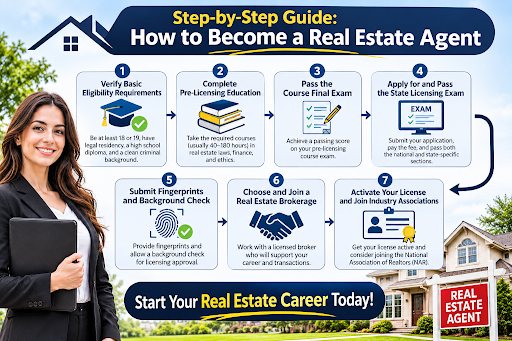
Regulations for real estate licenses differ from state, province, or country, so always check for precise requirements with your local real estate commission. The main pathway, however, is followed in most jurisdictions in a predictable sequence.
- Verify Basic Eligibility Requirements: Age 18 or 19, legal residency or work authorization, and a high school diploma or equivalent. You must also have a clean criminal background check since licensing boards check applicants’ criminal records before granting credentials.
- Complete Pre-Licensing Education: The number of pre-licensing hours depends on your local regulatory agency. This is anywhere between 40 hours and more than 180 hours, depending on your location. Courses include property law, agency relationships, real estate finance, contracts, ethics and calculations.
- Pass the Course Final Exam: Schools will require that you pass a proctored final exam for pre-licensing courses before taking the official state or provincial licensing exam. The best way to become familiar with the legal terminology and valuation formulas is to take practice tests over and over.
- Apply for and Pass the State Licensing Exam: Fee After completion of course submit exam application and fee. The official exam usually is composed of two parts, national or general principles, and local state-specific laws. The licensure requirement is to pass both sections.
- Submit Fingerprints and Background Check: Required to check criminal history, send Fingerprints and Background Check Licensing authorities. All previous felony and/or financial fraud convictions should be disclosed in the application process and screened by the commission prior to approval.
- Choose and Join a Real Estate Brokerage: Your license should be held by a licensed managing broker who oversees your transactions, trains you and is liable for your compliance.
- Activate Your License and Join Industry Associations: Many agents are also members of the National Association of Realtors or local boards to access the Multiple Listing Service, lockbox systems and standardized contract forms.
Startup Costs Every Beginner Should Budget For
The biggest error new agents can make is to become out of money in their first six months before they close their first deal. When it comes to building a client pipeline, a thorough startup budget can keep stress levels low.
Here is a simple, compact table that will fit neatly on a document or webpage.
Estimated Costs of Becoming a Real Estate Agent
| Expense Category | Typical Estimated Cost | Purpose |
| Pre-Licensing Course | 200–800 | Mandatory education required before taking the exam. |
| Exam & Application Fees | 100–300 | Exam scheduling, background checks, and license application. |
| Board and MLS Dues | 500–1,500/year | Access to property listing databases and property access keys. |
| Brokerage Desk or Tech Fees | 0–250/month | Office space, CRM software, and training. |
| Marketing and Branding | 300–1,000 | Business cards, yard signs, professional photos, and websites. |
| Living Expense Reserve | 3–6 months of expenses | Financial support while building your real estate business. |
Note: These are estimated costs and may vary depending on your state, brokerage, and location.
Refers to one’s own needs till first commission in order to surviveA month’s worth of personal living expenses at the minimum is enough runway to get to school and dedicate yourself to making your life work and searching.
Choosing the Right Brokerage as a New Agent
How long it takes you to close your first transaction will be a direct reflection of your first brokerage. For newbies, it is more beneficial to find a mentor, get some practical training, and become a leader in a way that is easy to access rather than aiming for a high commission split.
Types of Real Estate Brokerages
- Traditional Full-Service Franchises: Brands with standardized training, physical location, local reputation and mentors in the company. Commission splits usually begin at the lower end first, e.g., 60/40 or 70/30, until you reach production quotas.
- Cloud-Based Brokerages: Virtual companies that have low overheads in the office. They may provide higher commission rates, revenue-sharing, and online training libraries, but since they are not in a physical workplace, self-discipline must be exercised.
- Boutique Local Brokerages: Independent companies that are very knowledgeable about a particular community or specialty. They will frequently give one to one coaching and a close-knit team atmosphere.
- Flat-Fee or 100% Commission Brokerages: Brokerages that pay a flat transaction fee or a flat monthly desk fee. The latter are usually more appropriate for more advanced agents who don’t require daily supervision.
Questions to Ask During Brokerage Interviews
When considering hiring an independent contractor, interview at least three different brokerages and ask questions:
- What training & mentorship programs do you have for agents during their first 90 days?
- Who is on hand to help answer urgent contract questions after hours, on weekends?
- Do they charge any hidden fees like errors and omissions insurance fees, desk fees, or franchise fees?
- Do you give me company generated leads or do I have to generate 100% of my own leads?
- How is the commission divided and will the percentage go up if I am able to close more volume?
Essential Skills Needed to Succeed in Real Estate
The passing of the licensing exam does not indicate that you have a working knowledge of real estate law, it does not mean that you will automatically be able to find clients or close deals. Successful agents cultivate a combination of interpersonal, analytical and organizational skills.
Communication and Active Listening
The more important the financial choice, the more clients want advice that is listening to what they have to say and not pressuring a sale. Inquiries of why a family is relocating, when they are going, and what they cannot live without, will help match them to their ideal home and build a lasting trust in you.
Local Market Expertise
It’s just having a bigger knowledge of the stock than anyone else in the game. Every weekend, visit open houses; research neighborhood price per square foot trends; follow school district borders; and find out about proposed commercial developments. As you use the local market with confidence, people will assume that you are the authority.
Negotiation and Problem Solving
Nearly every real estate transaction comes to a roadblock when the home doesn’t appraise for the price, there’s a question about a roof repair on the inspection report, or a financing delay. The best agents know how to remain calm in the heat of the moment, to keep the emotions out of the equation and to offer ideas that propel the process forward while buyers and sellers are navigating toward the closing table.
Time Management and Self-Discipline
If your time is not being tracked by a boss, it’s simple to spend an hour or more putting together folders or making social media graphics instead of speaking with prospective clients. The successful agents make their mornings sacred for income-building pursuits such as prospecting and follow-up, and leave any administrative duties to the afternoon.
Proven Lead Generation Strategies for Beginners
Lead generation is the source of life for your company. It doesn’t take a big advertising budget to start getting clients; consistent free and low-cost techniques work!
Working Your Sphere of Influence
Your sphere of influence consists of people who know, like and trust you – friends, family, neighbors, former classmates, service providers, etc. Don’t send a sales pitch – call, text or meet for coffee with each person. Let them know you are in the game of real estate, provide an interesting tidbit about the local real estate market, and ask who they know that may be interested in buying or selling this year.
Leveraging Open Houses
If you haven’t got any listings yet, inquire with the best producers in your brokerage if you can host an open house for their listings in your building. Come early, set up signage at nearby crossroads, greet guests with enthusiasm and ask questions that can be answered in a variety of ways such as: How did you get outside today? What are you looking at? What neighborhoods are you visiting? Send a helpful e-mail or text message within 24 hours, with similar properties.
Building an Authentic Online Presence
Almost every buyer and seller nowadays performs an online search of the agent’s name before hiring his services. Create a Google Business Profile, improve your Instagram, Facebook and LinkedIn business pages, and prioritize educational content. Short videos that debunk myths about down-payment, closing costs or local neighborhood features place you as an approachable educator instead of a salesperson pushing.
Door Knocking and Geographic Farming
Choosing a specific neighborhood between 200 – 500 homes, and reporting monthly market updates, sold listings, and community news creates long-term brand awareness. This strategy generally requires between 6 months and a year to show consistent listings but makes you the local professional real estate expert.
Your First 90 Days: Action Plan for New Agents
A roadmap to prevent overwhelm in the first three months. Slowly take this step by step plan to get momentum going rapidly.
Days 1 to 30: Setup and Foundation
- Finish all required brokerage paperwork, technology and compliance training.
- Capture all of your contacts from your phone, email and social media and put them into a Customer Relationship Management database.
- Call and handwrite notes to top 50 people about your new career.
- You should review at least 10 to 15 homes that are on the market weekly to get details on floor plans, neighborhoods and prices.
- Shadow a mentor or senior agent when showing a listing and a buyer.
Days 31 to 60: Visibility and Prospecting
- Set aside two hours each weekday morning to focus on lead generation – before checking your emails.
- Have one open house per week-end and practice speaking with buyers and collecting contact information.
- Share 2-3 educational social media posts each week about local housing statistics or tips for new home buyers.
- Work on contract writing: go over sample purchase contracts with your managing broker.
Days 61 to 90: Pipeline Conversion and Follow-Up
- Follow up with all the leads you come across at open houses, networking events and social media connections.
- Have a little meet-up or coffee with your main client base.
- Track daily activity metrics with mentors to learn which lead sources are driving the most conversations.
- Update your presentation packets for buyers and sellers with local market charts and quotes from first-time clients and colleagues.
Common Mistakes New Real Estate Agents Must Avoid
Understanding of common pitfalls will help you avoid expensive delays in your early career.
- Treating Real Estate Like a Hobby: If you work on Real Estate only when you feel like it, you don’t get regular income. Make your schedule as important as a job.
- Neglecting Follow-Up: Research after research demonstrates that the majority of real estate transactions occur between five and twelve touchpoints in the follow-up process. If you only call one employee and get no answer, thousands of dollars are lost.
- Over-Investing in Shiny Gadgets: Commission check for income taxes can cause major financial difficulties when filing taxes. Keep a separate business account at the bank from the beginning. Be careful to not have too many overheads until you have a consistent commission income.
- Failing to Pre-Qualify Buyers: If a buyer is shown a home for several weeks without having pre-qualified with a mortgage lender they are wasting their time and their home may not be a good fit for them.
Frequently Asked Questions for Beginner Agents
How long does it take to become a licensed real estate agent?
The whole process takes about 2-4 months for most people. The pre-licensing courses are completed online, which can be done in a few weeks for full-time students and 2-3 months for part-time students, depending on the individual and the course’s schedule, after which a few weeks are spent preparing for the exam and background check.
Can I start real estate part-time while keeping my current job?
Yes, some agents work part-time to build revenue as they get their feet wet. You do have to have flexibility in your schedule, to accept calls from clients, provide property viewings at night/weekends, and attend property inspections and closings.
How long does it take to get paid after closing a deal?
A commission check is sent to your brokerage by the title company or closing attorney when the commission is paid with the signing of final closing documents and the transfer of funds. Your payout is issued by your brokerage, which subtracts its agreed split, and within a few days your account is open (1-5 business days).
Do I need to be good at math to pass the exam?
Basic arithmetic, percentages, fractions, and simple area calculations, like determining commission splits, property tax proportions, loan-to-value ratios and square footage, are all key components of real estate math. This section can be mastered with the help of a basic calculator and through practice with sample word problems.
Long-Term Strategies to Scale Your Real Estate Career
After you make your first few sales and get into a rhythm, you can move from making a living to making money significantly when you are a top producer.
- Specialize in a Profitable Niche: Sell to first time home buyers, luxury real estate relocations, commercial leases, or investment properties; it makes your marketing more focused and establishes extensive referral authority.
- Systematize Client Reviews: Request a detailed Google review from all of your happy customers and buyers immediately following close. When people read positive online reviews, they are more inclined to click through to your site.Positive online feedback will be a powerful force that draws organic inbound leads to your site.
- Build a Vendor Referral Network: Work with trusted mortgage lenders, home inspectors, contractors and insurance companies. When helping trusted local professionals grow their businesses, referrals go both ways.
- Hire Administrative Support: Doing paperwork, instead of prospecting and talking to clients, hire a part-time transaction coordinator to allow you to devote more hours to growing your sales.
There are rewards for persistence, for true caring, and for daily disciplined execution in the real estate market. Take time to get your licensing process right, pick the right brokerage, manage your start-up costs and ensure you’re consistent in your prospecting efforts, and you’ll have a successful career that will strengthen year-by-year.